Why Traction Therapy Matters: Manual, IST, and Decompression Explained
Spinal Traction
At Grovetown Chiropractic, spinal traction is an important part of helping patients recover, re-balance spinal health, reduce inflammation, and improve mobility. Although every patient receives a completely personalized care plan, virtually everyone benefits from traction in some form — whether it’s gentle hands-on traction, motion traction on our IST (Inter-segmental Traction) table, or advanced Decompression. Why? Because research shows traction helps reduce pressure on discs and joints, promotes nutrient flow, and restores motion to the spine. Put simply: traction makes your other treatments work better.
Imbibition
We aren’t talking about the kind of imbibing that might happen at a New Years Eve party. Your spinal discs must take in nourishment and must eliminate waste- like all the rest of the tissues of your body. With very few exceptions, your bodies’ joints have no direct blood supply and must rely on nourishment and respiration which is driven by motion at the joint. If your joints aren’t moving, they aren’t “breathing”. Accelerated degeneration ensues.
Your disc is even more special; It relies on an “imbibition” process. This occurs on a diurnal basis. When your body is upright, the pressures drive waste out of the disc and into the bones above and below. When you are recumbent (while sleeping), they should fill back up again- and lost motion defeats this cycle.
I’ve found that getting your joints moving with a good adjustment is indispensable in the interest of arriving at a healthy, pain-free spine. I’ve also found that various efforts of promoting traction upon the spine to “kick-start” the respiration process is a near- indispensable catalyst in the interest of seeing that you stay adjusted. Just like getting water flow going through a fish’s gills helps it get swimming again, getting respiration going in your spine helps it to get working normally again- and stay that way!

Why Traction Is a Body-Healing Tool (Not a “Thing We Do”)
When the spine is compressed — from everyday stress, posture, injuries, inflammation, and especially accidents — the discs and nerves take the hit. Traction combats that by gently opening space and allowing tissues to heal.
The benefits include:
Less pressure on discs
Less irritation to nerves
Reduced muscle guarding/spasms
Improved spinal mobility
Better circulation of hydration and nutrients
Long-term joint protection
You don’t always “feel” spinal healing happening, but traction is one of the physiological ways we change the long-term trajectory of spinal health.
Hands-On Manual Traction: Precision and Comfort
Manual traction is a hands-on approach where the doctor applies a controlled, gentle stretch. Because it’s customized in real time, manual traction is especially useful for patients who are:
Very tight, inflamed and guarded after an accident
Experiencing persistent neck or lower back stiffness
Sensitive to rapid movement or pressure
Early in the healing process
Why it matters:
Manual traction lets us control the movement and respond instantly to your feedback. It sets the stage for deeper improvement and prepares the tissues for future traction methods as healing progresses.
IST Traction Table: The Motion You Don’t Get by Stretching
The IST (Inter-Segmental Traction) table is one of our most-used therapies because it:
Creates gentle motion between the spinal joints
Pumps fluid in and out of discs like a sponge
Reduces stiffness and protective muscle spasm
Feels relaxing while working deeply
This motion improves the health of the discs and joints without force, and it helps restore the normal mechanics of the spine. Patients often say: “It feels like I’m finally loosening up without being twisted or popped.”
The IST traction table isn’t dramatic or flashy, but it’s effective, and most patients benefit from it at some phase of care.
Spinal Decompression: When Traction Gets More Strategic (Why It’s Worth Paying Extra For)
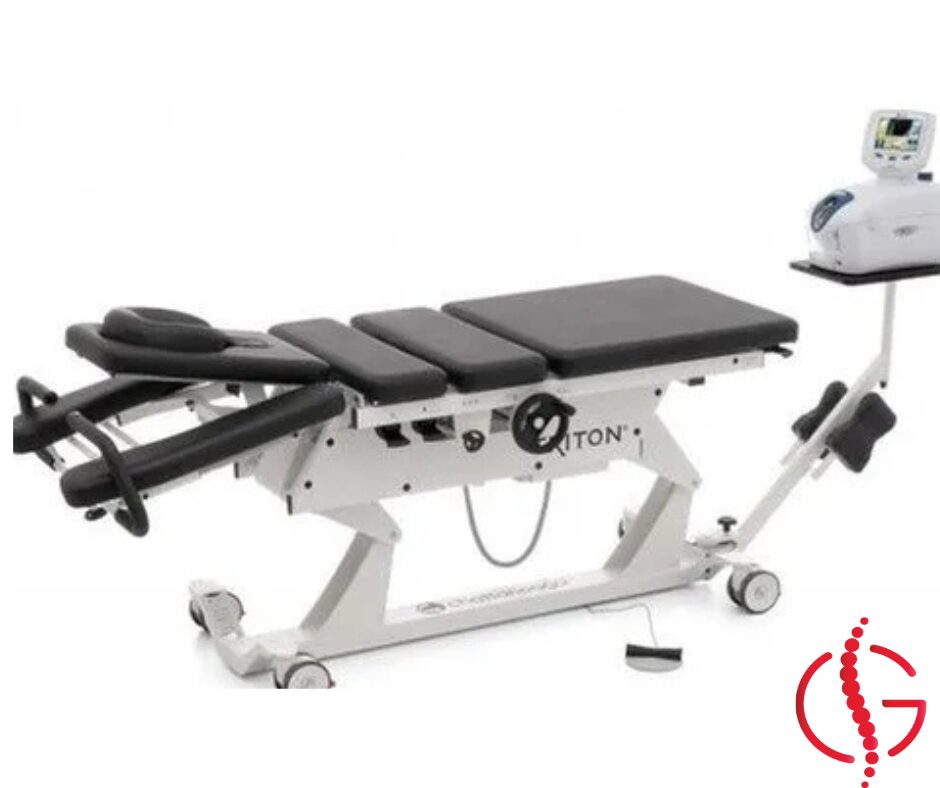
Spinal decompression is for people who need more than general stretching — those who need pressure inside the disc to change. This service is typically not covered by insurances.
Unlike general traction, decompression:
Creates a vacuum-like pressure change inside the disc
Acts on damaged areas much more deeply than stretching
Helps reduce bulging and irritation
Takes pressure off compressed nerves
Allows hydration and nutrients to enter the disc
This is extremely valuable for people with:
Disc bulges/herniations
Sciatica/radiating leg pain
Nerve compression
Chronic low back pain
Failed response to typical care
Spinal degeneration
It works in repeated cycles of a gentle pull-and-release pattern, allowing the discs time to respond physiologically — NOT mechanically. That’s why it isn’t a “one and done” treatment — it’s a process that can change the quality of the disc over time.
Why Decompression Costs More (and Why It Should)
We are upfront: For most people decompression is a Time-of Service (payment at time of service) therapy and it costs more than an adjustment encounter.
Here’s why patients are happy to pay:
It’s incredibly targeted
It requires specialized equipment
It provides outcomes that general traction cannot
It supports structural improvement, not just comfort
It’s not something every patient needs — but when it’s appropriate, it’s one of the most valuable tools we can offer someone to avoid surgery, reduce nerve symptoms, and improve long-term spinal health.
Traction Is a Process, Not a Protocol (Why Everyone’s Plan Is Different)
A patient recovering from a car accident is not treated the same way as someone dealing with chronic disc degeneration. Even two people with similar X-rays may respond differently.
Traction allows us to:
Start gently with manual methods
Progress to deep motion on the IST table
Expand into targeted disc decompression if needed
Your plan is based on:
Your pain level
Your mobility
Your spinal health
Your goals
Your stage of healing
No two patients get the exact same combination.
For Car Accident Patients
After a car accident:
Joints become stuck
Muscles tighten to protect the spine
Inflammation increases nerve sensitivity
Motion becomes restricted
Traction helps restore normal biomechanics and reduces the long-term consequences of whiplash or spinal compression. Even if decompression isn’t necessary, traction often prevents chronic issues from developing.
The Big Picture
Traction is not a “nice bonus” to chiropractic — it’s a therapeutic strategy that helps your spine recover, adapt, and function better long-term. Traction and distraction are elements of healthy spinal respiration.
Whether:
You’re in pain now
You had a recent accident
You have disc changes
You want to avoid future degeneration
Traction, in it’s many forms, gives us a scientifically grounded way to help your spine heal and stabilize.
WORKS CITED
Holm, S., A. Maroudas, J. P. G. Urban, G. Selstam, and A. Nachemson. “Nutrition of the Intervertebral Disc: Solute Transport and Metabolism.” Connective Tissue Research, vol. 8, no. 2, 1981, pp. 101–119, doi:10.3109/03008208109152130. Taylor & Francis Online+1Raj, P. Prithvi. “Intervertebral Disc: Anatomy-Physiology-Pathophysiology-Treatment.” Pain Practice, vol. 8, no. 1, Jan.–Feb. 2008, pp. 18–44, doi:10.1111/j.1533-2500.2007.00171.x. PubMed, https://pubmed.ncbi.nlm.nih.gov/18211591/. PubMed+1Cheng, Yu-Hsuan, Chih-Yang Hsu, and Yen-Nung Lin. “The Effect of Mechanical Traction on Low Back Pain in Patients with Herniated Intervertebral Disks: A Systematic Review and Meta-Analysis.” Clinical Rehabilitation, vol. 34, no. 1, 2020, pp. 13–22, doi:10.1177/0269215519872528. PubMed, https://pubmed.ncbi.nlm.nih.gov/31456418/. TMU Hub+1
Written by: Donaid Seals D.C
Dr. Seals is a practicing Doctor of Chiropractic with over 25 years of experience caring for people. His thinking is the product of his education, practice experience and many years in the natural foods and fitness industry. He has become living proof that old muscleheads don’t die-or fade away; sometimes they grow up to bring real-world expertise to the clinical picture. Traditional background information is available here.