Why Won’t My Pain Heal? The Red Pill Answer

There’s a famous scene in The Matrix. Neo is offered two pills. Take the blue one and he wakes up in his own bed, free to go on believing whatever he wants. Take the red one and he sees how things really are, whether he likes it or not.
If you’ve been living with pain for months or years, you’ve been offered the same choice. Maybe it’s an old injury that never quite settled down, or a back, neck or shoulder that has never been right since. You probably didn’t know a choice was on the table.
You’ve likely asked the question everyone asks: Why won’t this heal? It’s a reasonable question. It’s also the wrong one, and it may be what’s keeping you stuck.
The blue pill: keep managing, keep hoping
The blue pill is the world most pain patients live in, and it’s comfortable in its way. Everyone around you agrees on how it works. You hurt, so you take something.
It starts with ibuprofen. Then come the stronger prescriptions, the creams and patches, and the injection every few months. When one stops working, there’s always another to try.
Underneath it all sits an assumption nobody says out loud: somewhere in your body, an injury is still trying to heal. Keep the pain down, give it time, and one day it will finish. Your job is to wait.
To be fair, pain relief has its place. Some days it’s what gets you to work or lets you sleep. The trouble isn’t the pill. The trouble is the plan, because none of those things change what’s actually there. They turn down the signal. So, months become years, the prescriptions change, the problem doesn’t, and you’re still in the Matrix.
The red pill: it already healed
Here’s what you see once your eyes are open. For many people with long-standing pain, the problem isn’t that the injury won’t heal. The problem is that it already did.
It healed poorly. It healed incorrectly. And now it has set up just the way it is.
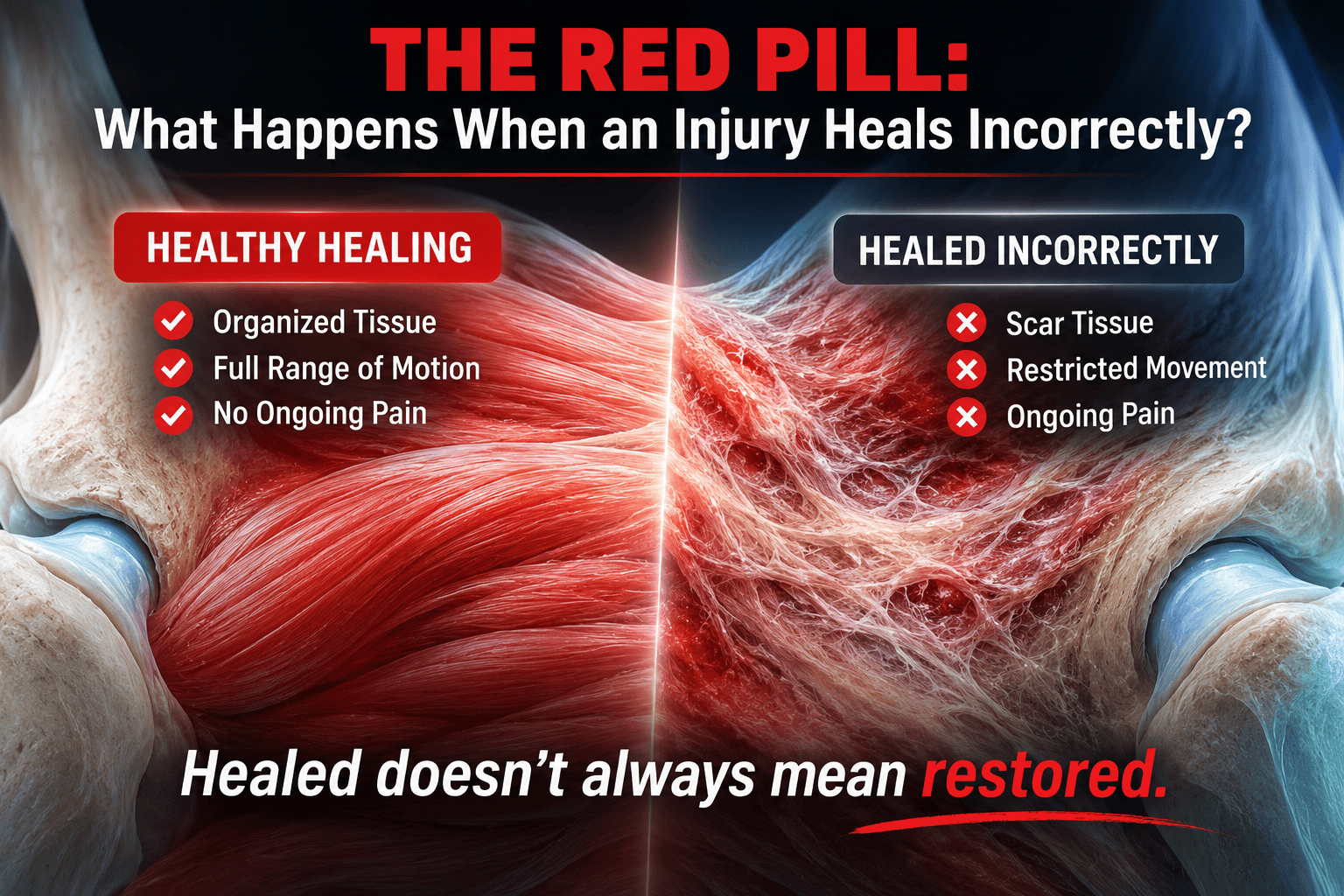
Your body doesn’t leave injuries open. It’s a relentless repair machine, and in most cases, it closes the job within weeks to months. But it’s aiming for done, not for perfect, and it does the work under poor conditions: pain, swelling and limited movement.
So damaged tissue gets patched with scar tissue that is less organized and less elastic than the original. Muscles that were guarding stay tight or quit showing up for work. Joints that stopped moving through their full range get stiff. Meanwhile you learned to shift your weight, favor one side, or turn from the shoulders instead of the neck. Eventually that becomes your normal.
That’s why the pain doesn’t just go away, and why it’s still there each time the medication wears off. You aren’t waiting on a healing process anymore. You’re living in the result of one.
Your disorder isn’t your pain
This is the part that changes everything. Pain is what you feel. The disorder is what’s producing it: a joint that doesn’t move, tissue that healed thick and stiff, a muscle that stopped doing its job, a movement pattern built to work around all of it.
If you define the problem as pain, the solution is anything that makes pain stop, and you stay on the blue pill. Define it as a physical disorder and you get better questions:
• What doesn’t move that should?
• What’s doing a job it wasn’t built to do?
• What could I do before that I can’t do now?
Those questions have answers you can examine, measure and work on.
The red pill comes with some unwelcome news: nobody can fix this by waiting, and time won’t fix it either. You have a project on your hands. Like any real project, it has a scope, a plan, work to be done, and signs that tell you whether it’s going well. It also has an owner, and that’s you.
What life looks like outside the Matrix
You may need help with this project. You absolutely need a change of mindset, because effort pointed in the wrong direction goes nowhere. Here’s where to start:
1. Change the question. Stop asking when it will go away. Start asking what it actually is.
2. Get the real picture. A pain score from one to ten won’t tell you much. You need someone to look at how your body moves, where it’s restricted, and what it’s compensating for.
3. Measure function, not just pain. How far can you walk? Can you check your blind spot, sleep on that side, or pick up your grandchild? These are the measures that matter, and they often improve before the pain does.
4. Do the work. Something that set up over months or years takes consistent effort to change. That means restoring motion, rebuilding strength, and retraining the habits your body picked up along the way.
5. Think long term. Progress won’t be a straight line. Tissues and muscles that have been idle may complain when you ask them to work again. The goal isn’t a good week. The goal is a body that works better for years to come.

Which pill will it be?
At Grovetown Chiropractic, we don’t treat pain as the diagnosis. We examine how your body is built and how it moves, find what healed wrong, and lay out the project in plain language. Then we work on it with you, using adjustments, soft tissue work, cryotherapy, modalities, decompression and rehab exercises, along with work you do on your own.
That’s what sets us apart. We won’t hand you another way to wait. We also won’t promise that every case can be fully resolved, or that the work is easy. Not all long-term pain comes from a poorly healed injury, which is why a proper exam comes first. If what we find isn’t something we can help with, we’ll tell you and point you in the right direction.
The blue pill will always be there. If you’re ready to see what’s really going on, the red pill starts with a conversation. Call us at 706-400-4333.
This article is general education, not medical advice. Please don’t stop or change prescribed medication without talking to your prescriber. Seek prompt medical care for sudden or severe pain, new numbness or weakness, loss of bladder or bowel control, or pain with fever.
Written by: Donaid Seals D.C
Dr. Seals is a practicing Doctor of Chiropractic with over 25 years of experience caring for people. His thinking is the product of his education, practice experience and many years in the natural foods and fitness industry. He has become living proof that old muscleheads don’t die-or fade away; sometimes they grow up to bring real-world expertise to the clinical picture. Traditional background information is available here.
Disclaimer: Consult with a healthcare provider before starting any new supplement/workout regimen, especially if you have underlying health conditions or take medications. The entire contents of this website are based upon the opinions of Dr. Seals, unless otherwise noted. Individual articles are based upon the opinions of the respective author, who retains copyright as marked. The information on this website is not intended to replace a one-on-one relationship with a qualified health care professional and is not intended as medical advice. It is intended as a sharing of knowledge and information from the research and experience of Dr. Seals and his community. Dr. Seals encourages you to make your own health care decisions based upon your research and in partnership with a qualified health care professional.